

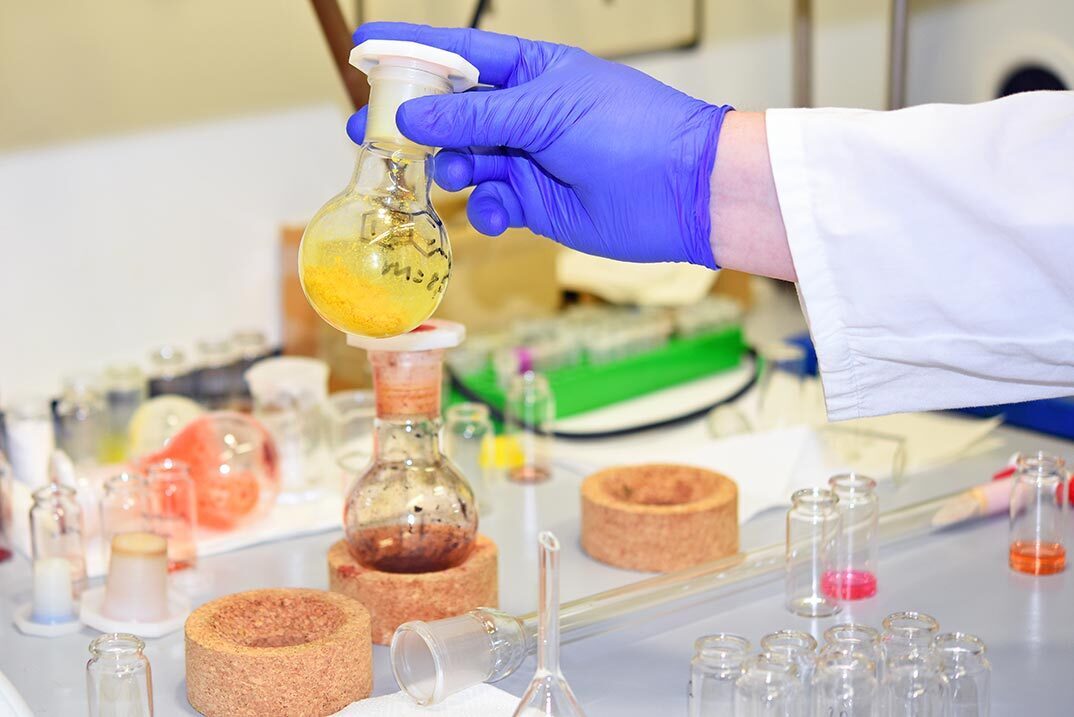
This best-selling and highly rated programme provides essential knowledge to work effectively in various healthcare settings, education environments, laboratories, research institutions and science-based industries where a strong understanding of inorganic chemistry is required.

Our comprehensive Inorganic Chemistry Certification Course equips you with in-depth theoretical understanding, scientific frameworks and analytical approaches required to understand the behaviour, structure and reactions of inorganic substances. Designed for learners seeking a solid foundation, this course aligns with UK academic and professional standards.

This Inorganic Chemistry course focuses on the core principles governing elements, compounds, coordination chemistry and periodic trends. You will develop a clear understanding of atomic structure, bonding theories and the chemical behaviour of metals and non-metals across the periodic table.

Through this Inorganic Chemistry online course, you will explore oxidation states, crystal field theory, coordination compounds, transition metals and reaction mechanisms that underpin modern chemistry and materials science. The course also explains how inorganic chemistry supports pharmaceutical development, industrial processes, environmental science and advanced research.

This Inorganic Chemistry Certification further strengthens your ability to analyse chemical data, interpret theoretical models and understand how inorganic systems behave under different conditions. You will gain the scientific confidence required to progress in chemistry-related study, research or technical roles.

By enrolling in this CPD-accredited Inorganic Chemistry Course, you gain recognised knowledge, academic credibility and professional development that supports careers and further education within chemistry, science teaching and laboratory-based sectors in the UK.

Course Overview

Career-focused Inorganic Chemistry Certification designed for UK science and education pathways

  • Fully online learning with 365-day access
  • CPD-accredited chemistry course aligned with UK standards
  • Covers atomic structure, bonding and periodic trends
  • Explores coordination chemistry and transition metal compounds
  • Develops understanding of oxidation states and reaction behaviour
  • Supports progression into science, research and education roles
  • Suitable for academic development and career enhancement
  • Ideal for students, educators and science professionals

By the end of this Inorganic Chemistry Certification, you will be able to:

  • Understand the fundamental principles of inorganic chemistry
  • Explain atomic structure and chemical bonding theories
  • Analyse periodic trends and elemental behaviour
  • Understand coordination compounds and transition metal chemistry
  • Interpret oxidation states and redox processes
  • Explain crystal field theory and ligand interactions
  • Apply theoretical chemistry knowledge to scientific contexts
  • Support further study or professional development in chemistry
  • Chemical theory comprehension
  • Analytical and critical thinking skills
  • Scientific terminology and interpretation
  • Data analysis and reasoning skills
  • Problem-solving in chemistry contexts
  • Academic research awareness
  • Organised scientific thinking
  • Conceptual modelling skills

This Inorganic Chemistry Certification Course is ideal for:

  • Students pursuing chemistry or science qualifications
  • Aspiring laboratory technicians and researchers
  • Science teachers and educators
  • University applicants strengthening subject knowledge
  • Career changers entering scientific fields
  • Professionals working in science-based industries
  • Anyone seeking a recognised UK inorganic chemistry certification

When you enrol with Teachers Training, you benefit from:

  • A dedicated UK education and training platform
  • 24/7 tutor and technical support
  • Interactive and engaging online learning materials
  • Affordable pricing with no hidden costs
  • Courses aligned with UK academic and professional frameworks
  • 100 per cent online access
  • Flexible learning deadline
  • Instant access after enrolment

There are no formal entry requirements for this Inorganic Chemistry Certification Course. To enrol, you should:

  • Have an interest in chemistry and science
  • Possess a basic understanding of the English language
  • Be motivated and committed to learning
  • No previous qualifications or experience are required

After completing this Inorganic Chemistry Certification, you can progress into roles such as:

  • Laboratory Assistant
  • Science Technician
  • Chemistry Research Support Officer
  • Science Teaching Assistant
  • Quality Control Assistant
  • Environmental Science Assistant
  • Further study in chemistry or materials science

The assessment is straightforward; you need to complete the assignment questions that will be provided to you at the end of this  course, you can complete the assignment anytime you want. After you complete and submit your assignment, our tutors will assess your assignment and give you feedback if needed. 

After your assignment has been assessed and you have passed, you will be qualified and will be able to apply for a course completion certificate.

Upon completing the course and passing the final assessment, you will be eligible to receive a CPD QS Accredited Certificate from The Teachers Training, which demonstrates your professional knowledge and career readiness. You can select your preferred certificate option at discounted rates, with the Digital CPD Certificate (PDF) available for only £6.99, the Printed Hardcopy Certificate for only £9.99, or both the Digital and Printed Certificates together for just £11.99. This certification will significantly strengthen your CV and enhance your credibility within the education sector. Please note that discounted certificate pricing is available for a limited time only, so be sure to secure your certificate before the offer ends.

This best-selling and highly rated programme provides essential knowledge to work effectively in various healthcare settings, education environments, laboratories, research institutions and science-based industries where a strong understanding of inorganic chemistry is required.

Our comprehensive Inorganic Chemistry Certification Course equips you with in-depth theoretical understanding, scientific frameworks and analytical approaches required to understand the behaviour, structure and reactions of inorganic substances. Designed for learners seeking a solid foundation, this course aligns with UK academic and professional standards.

This Inorganic Chemistry course focuses on the core principles governing elements, compounds, coordination chemistry and periodic trends. You will develop a clear understanding of atomic structure, bonding theories and the chemical behaviour of metals and non-metals across the periodic table.

Through this Inorganic Chemistry online course, you will explore oxidation states, crystal field theory, coordination compounds, transition metals and reaction mechanisms that underpin modern chemistry and materials science. The course also explains how inorganic chemistry supports pharmaceutical development, industrial processes, environmental science and advanced research.

This Inorganic Chemistry Certification further strengthens your ability to analyse chemical data, interpret theoretical models and understand how inorganic systems behave under different conditions. You will gain the scientific confidence required to progress in chemistry-related study, research or technical roles.

By enrolling in this CPD-accredited Inorganic Chemistry Course, you gain recognised knowledge, academic credibility and professional development that supports careers and further education within chemistry, science teaching and laboratory-based sectors in the UK.

Course Overview

Career-focused Inorganic Chemistry Certification designed for UK science and education pathways

  • Fully online learning with 365-day access
  • CPD-accredited chemistry course aligned with UK standards
  • Covers atomic structure, bonding and periodic trends
  • Explores coordination chemistry and transition metal compounds
  • Develops understanding of oxidation states and reaction behaviour
  • Supports progression into science, research and education roles
  • Suitable for academic development and career enhancement
  • Ideal for students, educators and science professionals

Learning Outcomes

By the end of this Inorganic Chemistry Certification, you will be able to:

  • Understand the fundamental principles of inorganic chemistry
  • Explain atomic structure and chemical bonding theories
  • Analyse periodic trends and elemental behaviour
  • Understand coordination compounds and transition metal chemistry
  • Interpret oxidation states and redox processes
  • Explain crystal field theory and ligand interactions
  • Apply theoretical chemistry knowledge to scientific contexts
  • Support further study or professional development in chemistry

Skills You Will Gain

  • Chemical theory comprehension
  • Analytical and critical thinking skills
  • Scientific terminology and interpretation
  • Data analysis and reasoning skills
  • Problem-solving in chemistry contexts
  • Academic research awareness
  • Organised scientific thinking
  • Conceptual modelling skills

Who Is This Course For?

This Inorganic Chemistry Certification Course is ideal for:

  • Students pursuing chemistry or science qualifications
  • Aspiring laboratory technicians and researchers
  • Science teachers and educators
  • University applicants strengthening subject knowledge
  • Career changers entering scientific fields
  • Professionals working in science-based industries
  • Anyone seeking a recognised UK inorganic chemistry certification

Why Choose Teachers Training

When you enrol with Teachers Training, you benefit from:

  • A dedicated UK education and training platform
  • 24/7 tutor and technical support
  • Interactive and engaging online learning materials
  • Affordable pricing with no hidden costs
  • Courses aligned with UK academic and professional frameworks
  • 100 per cent online access
  • Flexible learning deadline
  • Instant access after enrolment

Entry Requirements For this course

There are no formal entry requirements for this Inorganic Chemistry Certification Course. To enrol, you should:

  • Have an interest in chemistry and science
  • Possess a basic understanding of the English language
  • Be motivated and committed to learning
  • No previous qualifications or experience are required

Career Path

After completing this Inorganic Chemistry Certification, you can progress into roles such as:

  • Laboratory Assistant
  • Science Technician
  • Chemistry Research Support Officer
  • Science Teaching Assistant
  • Quality Control Assistant
  • Environmental Science Assistant
  • Further study in chemistry or materials science

Assessment

The assessment is straightforward; you need to complete the assignment questions that will be provided to you at the end of this course. You can complete the assignment anytime you want. After you complete and submit your assignment, our tutors will assess your assignment and give you feedback if needed. 

After your assignment has been assessed and you have passed, you will be qualified and will be able to apply for a course completion certificate.

Certification

Upon completing the course and passing the final assessment, you will be eligible to receive a CPD QS Accredited Certificate from The Teachers Training, which demonstrates your professional knowledge and career readiness. You can select your preferred certificate option at discounted rates, with the Digital CPD Certificate (PDF) available for only £6.99, the Printed Hardcopy Certificate for only £9.99, or both the Digital and Printed Certificates together for just £11.99. This certification will significantly strengthen your CV and enhance your credibility within the education sector. Please note that discounted certificate pricing is available for a limited time only, so be sure to secure your certificate before the offer ends.

Schema Markup

FAQ Schema Markup

FAQ - Frequently Asked Questions

It covers atomic structure, chemical bonding, periodic trends, coordination chemistry, oxidation states, transition metals and theoretical inorganic chemistry principles.

No. This course is suitable for beginners and learners seeking to strengthen their chemistry knowledge.

Yes. You will receive a CPD-accredited certificate upon successful completion.

Yes. The course is fully accessible on desktop, tablet and mobile devices.

Yes. This course is CPD-accredited and recognised across the UK for professional development.

Course Curriculum

Unit 01: ABOUT THE COURSE
Learning objectives 00:10:00
Example of a solved problem 00:06:00
Unit 02: Quantities and Units
System of measurement 00:02:00
International system of units 00:05:00
Temperature units and scales 00:04:00
Use and misuse of units 00:03:00
Dimensional analysis 00:03:00
Quantities and units: Solved problems 00:10:00
Unit 03: Atomic, Molecular and Molar Masses
Atoms 00:02:00
Nuclei 00:04:00
Periodic table 00:08:00
Relative atomic masses 00:04:00
Moles 00:05:00
Symbols, formulas and molar masses 00:04:00
Atomic, molecular and molar masses – Problems with solutions 00:16:00
Unit 04: Formulas and Compositions
Empirical formula from composition 00:04:00
Composition from formula 00:04:00
Nuclidic molecular masses and chemical formulas 00:05:00
Formulas and compositions: Solved problems 00:24:00
Unit 05: Inorganic Nomenclature
Introduction to nomenclature 00:03:00
Naming binary compounds of nonmetals 00:05:00
Naming ionic compounds 00:01:00
Naming monoatomic cations 00:06:00
Naming polyatomic cations 00:03:00
Naming monoatomic anions 00:02:00
Naming oxyanions 00:05:00
Naming special anions 00:01:00
Putting the names of the ions together 00:02:00
Writing formulas for ionic compounds 00:08:00
Naming inorganic acids 00:06:00
Naming acid salts 00:04:00
Naming hydrates 00:01:00
Unit 06: Chemical Equations
Introduction to chemical equations 00:02:00
Molecular relations from equations 00:05:00
Mass relations from equations 00:06:00
Limiting reactant 00:01:00
Calculations from chemical equations: Solved problems 00:24:00
Types of chemical reactions 00:04:00
Unit 07: Measurement of Gases
Pressure 00:07:00
Gas laws 00:02:00
Boyle’s law: Constant temperature 00:01:00
Charles’ law: Constant pressure 00:01:00
Gay-Lussac’s law: Constant volume 00:01:00
Combined gas law 00:01:00
Density of an ideal gas 00:03:00
Dalton’s law for partial pressures 00:01:00
Collecting a gas over a liquid 00:02:00
Deviation from ideal beahvior 00:01:00
Measurement of gases: Solved problems 00:13:00
Unit 08: The Ideal Gas Law
Avogadro’s hypothesis 00:03:00
Molar volume 00:01:00
Ideal gas law 00:05:00
Gas volume relations from equations 00:04:00
Gas stoichiometry involving mass 00:05:00
The ideal gas law: Solved problems 00:13:00
Unit 09: Thermochemistry
Heat 00:04:00
Energy and enthalpy 00:05:00
Enthalpy changes for various processes 00:12:00
Rules of thermochemistry 00:09:00
Thermochemistry – Problems with solutions 00:21:00
Unit 10: Atomic Structure
Characters of light 00:05:00
Interaction of light with matter 00:08:00
Particles and waves 00:03:00
Orbitals 00:17:00
The Pauli exclusion principle 00:01:00
Aufbau principle 00:03:00
Electron configuration 00:11:00
Atomic radii 00:04:00
Ionization energies 00:03:00
Electron affinity and magnetic properties 00:05:00
Atomic structure – Problems with solutions 00:16:00
Unit 11: Chemical Bonding and Molecular Structure
Introduction to chemical bonding 00:02:00
Octet rule 00:03:00
Ionic bonding 00:09:00
Electron dot notation 00:05:00
Covalent bonding 00:17:00
Distinction between ionic and covalent bonding 00:03:00
Predicting the nature of bonding in compounds 00:05:00
Formal charges 00:08:00
Dipole moment and electronegativity 00:04:00
Hybrid orbitals 00:10:00
Unit 12: Solids and Liquids
Crystals 00:08:00
Close packing 00:04:00
Crystal forces 00:06:00
Liquid forces 00:03:00
Solids and liquids: Solved problems 00:22:00
Unit 13: Oxidation - Reduction
Introduction to redox reactions 00:04:00
Oxidation number 00:09:00
Oxidizing and reducing agents 00:05:00
Ionic notation for equations 00:04:00
Balancing oxidation-reduction equations 00:11:00
Oxidation-reduction: Solved problems 00:14:00
Unit 14: Concentration of Solutions
Composition of solutions 00:01:00
Concentrations 00:02:00
Molarity 00:02:00
Normality 00:05:00
Molality 00:01:00
Mole fraction 00:01:00
Comparison and summary of the concentration units 00:04:00
Dilution problems 00:01:00
Concentration of solutions: Solved problems 00:14:00
Unit 15: Reaction Involving Standard Solutions
Reactions involving standard solutions 00:04:00
Reaction involving standard solutions: Solved problems 00:13:00
Unit 16: Properties of Solutions
Introduction to chemical solutions 00:02:00
Vapor pressure lowering 00:04:00
Freezing point lowering 00:05:00
Boiling point lowering 00:03:00
Osmotic pressure 00:03:00
Solution of gases in liquids 00:02:00
Law of distribution 00:01:00
Properties of solutions: Solved problems 00:13:00
Unit 17: Thermodynamics
The first law 00:02:00
The second law 00:06:00
Entropy 00:04:00
The third law 00:01:00
Standard states 00:06:00
Chemical equilibrium 00:03:00
The equilibrium constant 00:10:00
Le Chatelier’s principle 00:14:00
Thermodynamics – Problems with solutions 00:18:00
Unit 18: Acids and Bases
Arrhenius concept 00:03:00
Brönsted-Lowry concept 00:08:00
Lewis concept 00:02:00
Ionization of water 00:07:00
Hydrolysis 00:06:00
Buffer solutions 00:06:00
Indicators 00:03:00
Polytropic acids 00:05:00
Titration 00:08:00
Acids and bases – Problems with solutions 00:21:00
Unit 19: Complex Ions and Precipitates
Coordination complexes 00:08:00
Solubility product 00:02:00
Precipitation 00:05:00
Complex ions and precipitates: Solved problems 00:06:00
Unit 20: Electrochemistry
Electrical units 00:03:00
Faraday’s laws 00:04:00
Voltaic cells 00:06:00
Standard half-cell potential 00:07:00
Combining couples 00:04:00
Free energy and Nernst equation 00:08:00
Electrolysis 00:06:00
Electrochemistry: Solved problems 00:16:00
Unit 21: Rates of Reactions
Introduction to rates of reactions 00:01:00
Rate constants and order of reactions 00:11:00
First order reactions 00:02:00
Other rate laws 00:01:00
Energy of activation 00:01:00
Mechanism of reaction: Molecularity 00:05:00
Mechanism of reaction: Energetics 00:05:00
Rates of reactions: Solved problems 00:13:00
Review

COURSE REVIEWS