


When a child knows what they want to say but struggles to get the words out clearly, everyday communication can become frustrating. They might pronounce the same word differently each time, struggle with longer words or find it difficult to coordinate the sounds needed for speech.
These can be signs of childhood apraxia of speech (CAS), a motor speech disorder affecting how the brain plans and coordinates movements for speaking. In the UK, the condition has also been known as developmental verbal dyspraxia.
Recognising possible signs and seeking appropriate support can help children communicate more confidently. This guide explains the symptoms, causes, assessment and treatment of CAS, alongside practical strategies for parents and teachers.
Build Your Knowledge of Speech and Language Support
Supporting children with communication difficulties starts with relevant knowledge. Teachers Training’s Speech and Language Therapy Diploma introduces speech development, communication difficulties and approaches to supporting children’s speech and language needs.
This online course supports professional development but does not qualify learners to diagnose CAS or practise as registered speech and language therapists.
What Is Childhood Apraxia of Speech?
Childhood apraxia of speech is a neurological motor speech disorder that affects the planning and sequencing of movements needed to produce speech.
When speaking, the brain must coordinate movements of the lips, tongue and jaw. Children with CAS have difficulty planning these movements accurately, even when their speech muscles are not weak.
For example, a child might pronounce “banana” correctly once but struggle to repeat it. Longer words may be particularly challenging because they require more complex sequences of movements.

CAS primarily affects speech motor planning. A child may understand language well, although language or other developmental difficulties can also occur alongside CAS.
The Royal College of Speech and Language Therapists (RCSLT) recognises childhood apraxia of speech as the preferred UK terminology, replacing the older term developmental verbal dyspraxia.
What Are the Early Signs of Childhood Apraxia of Speech?
Early signs of childhood apraxia of speech may include inconsistent pronunciation, difficulty copying speech sounds, disrupted transitions between sounds and unusual speech rhythm. These signs vary by age and require professional assessment.
Signs in Toddlers and Younger Children
Possible early signs include:
- Using fewer spoken words than expected for their developmental stage.
- Having difficulty imitating speech sounds or simple words.
- Producing the same word differently across attempts.
- Finding it difficult to combine sounds into words.
- Using gestures more frequently when speech is difficult.
These signs can also occur with other speech and language difficulties. They do not confirm CAS on their own.
Signs in Older Children
As speech develops, children with CAS may demonstrate:
- Inconsistent speech errors: Saying the same word differently on separate attempts.
- Difficulty transitioning between sounds: Speech may sound interrupted or effortful.
- Unusual speech rhythm: Stress or emphasis may fall on unexpected syllables.
- Difficulty with longer words: Multisyllabic words may be harder to produce accurately.
- Vowel and consonant errors: Certain sounds may be distorted or produced inconsistently.
According to Speech and Language UK’s information on CAS, these characteristics can help professionals identify children who may need further assessment.
Not every speech sound difficulty indicates CAS. For example, speech sound difficulties such as a lisp involve different speech production challenges.
What Causes Childhood Apraxia of Speech?
Childhood apraxia of speech occurs when the brain has difficulty planning and programming the movements required for speech.
In many children, the precise cause remains unknown. Some cases are associated with genetic conditions, neurological differences or broader developmental disorders.
CAS is not caused by a child being unwilling to speak, a lack of effort or inadequate parenting.
Importantly, CAS is different from speech difficulties caused primarily by muscle weakness. The central difficulty involves planning and coordinating movements rather than simply producing enough muscular force.
Although researchers continue to investigate its causes, identifying the child’s communication needs is more useful than assuming one explanation applies to every case.
How Is Childhood Apraxia of Speech Diagnosed?
A qualified speech and language therapist (SLT) with appropriate experience assesses suspected childhood apraxia of speech.
Diagnosis involves examining patterns of speech production rather than relying on a single symptom or test.
What Happens During an SLT Assessment?
An SLT may assess:
- How the child produces individual speech sounds.
- Whether pronunciation changes when words are repeated.
- How smoothly the child moves between sounds and syllables.
- Speech rhythm, stress and intonation.
- The child’s broader speech, language and communication development.

The therapist may also consider hearing, oral movement and other conditions that could explain the child’s difficulties.
The RCSLT’s position paper on childhood apraxia of speech provides professional guidance on assessment and terminology.
At What Age Can CAS Be Diagnosed?
There is no single age at which every child can be reliably diagnosed.
Assessment can be particularly challenging in children under three because their speech skills are still developing and they may produce too little speech for a confident diagnosis.
However, parents should not wait for a definite diagnosis before seeking advice.
If concerns persist, families can speak with their GP, health visitor or local NHS speech and language therapy service about assessment arrangements.
Develop Your Knowledge of SEN Support
For education professionals supporting children with additional communication needs, the SEN Teaching Assistant Level 4 course covers special educational needs, communication and interaction, and inclusive educational approaches. It can help build broader knowledge of supporting pupils with diverse learning needs.
Childhood Apraxia of Speech vs Other Communication Difficulties
CAS can resemble other speech and communication conditions. However, the underlying difficulties are not necessarily the same.
| Condition | Main difficulty |
|---|---|
| Childhood apraxia of speech | Planning and sequencing movements needed for speech |
| Speech delay | Developing speech sounds later than expected |
| Articulation disorder | Producing particular speech sounds accurately |
| Selective mutism | Speaking in certain situations because of anxiety |
| Language disorder | Understanding or expressing language |
For example, a child experiencing difficulty speaking in certain situations may speak comfortably at home but struggle to speak at school.
A child with CAS, however, experiences speech motor planning difficulties that are not limited to particular social situations.
Similarly, receptive and expressive language difficulties affect understanding or using language, rather than speech motor planning alone.
These conditions can coexist, making professional assessment important.
For teaching assistants supporting pupils with different communication and learning needs, Teachers Training’s SEN Teaching Assistant course introduces SEN support, communication and inclusive classroom approaches.
What Treatment Helps Childhood Apraxia of Speech?
Childhood apraxia of speech is generally treated through individualised, motor-based speech and language therapy. A qualified SLT selects practice activities and communication supports according to the child’s needs.
Individualised Speech and Language Therapy
An SLT may use structured activities that help children practise planning and coordinating speech movements.
Treatment may involve:
- Practising carefully selected speech sounds and words.
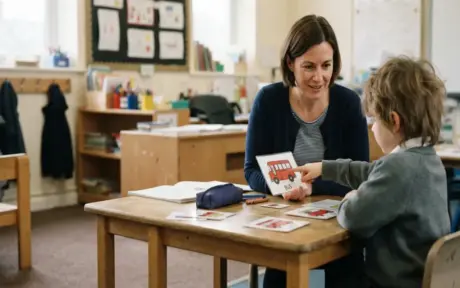
- Using visual, auditory or tactile cues when appropriate.
- Repeating speech movements with professional guidance.
- Gradually increasing the complexity of speech tasks.
- Reviewing progress and adjusting therapy goals.
Specialist approaches may include motor-based treatment programmes, selected according to the child’s needs.
Exercises such as blowing bubbles or strengthening the tongue are not established treatments for CAS simply because they involve mouth movements.
Supporting Communication Beyond Speech
Children may benefit from augmentative and alternative communication (AAC), including gestures, pictures, communication boards or electronic devices.
AAC helps children express themselves while speech skills develop. It should not be viewed as giving up on spoken communication.

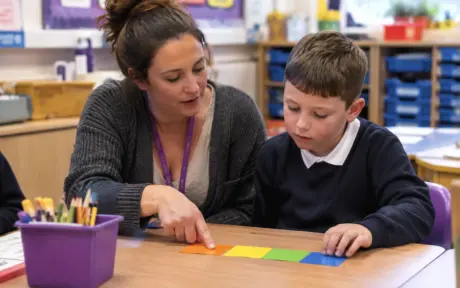
Some children may also need separate support with sentence development. For example, visual sentence-building strategies can support language organisation, although they are not a treatment for CAS itself.
How Can Parents and Teachers Support a Child With CAS?
Everyday communication support can reduce frustration and help children participate in family activities and classroom learning.
The aim is to make communication easier while following the child’s individual SLT recommendations.
Helping at Home
Parents and carers can support children by:
- Giving them time: Allow children to finish communicating without rushing or completing every word.
- Responding to meaning: Focus on what the child wants to communicate rather than correcting every pronunciation.
- Offering choices: Pictures, objects or gestures can make expressing preferences easier.
- Following therapy guidance: Practise activities recommended by the child’s SLT rather than introducing unfamiliar speech exercises.
- Recognising effort: Encourage participation without requiring repeated attempts when the child is tired or frustrated.
Shared reading, play and ordinary conversations provide valuable opportunities for communication, even when speech is unclear.
Supporting Children in the Classroom
Teachers and teaching assistants can make small adjustments that improve participation.
For example, they can:
- Allow additional time for spoken responses.
- Accept pointing, pictures, writing or AAC where appropriate.
- Avoid unexpected demands to speak in front of the class.
- Prepare children for speaking activities.
- Check understanding without relying exclusively on verbal answers.
- Coordinate strategies with parents, SENCOs and the child’s SLT.

These adjustments can form part of broader communication-friendly classroom strategies.
Teachers should also recognise that communication differences have different causes. For instance, repeating words and phrases is not itself a defining sign of CAS.
The Speech and Language UK guidance for educators offers additional information about supporting children with CAS in educational settings.
Build Skills for Inclusive Classroom Support
Children with ongoing communication difficulties may benefit from consistent, individualised support throughout their education. Teachers Training’s Teaching Assistant Level 3 Diploma covers classroom support, communication and working with pupils with additional educational needs.
Will a Child With Apraxia Ever Speak Clearly?
Many children with childhood apraxia of speech make meaningful improvements through appropriate speech and language therapy.
However, progress varies. Some children develop increasingly clear speech, while others experience persistent difficulties and benefit from longer-term support.
There is no reliable timetable that applies to every child.
Factors such as the severity of speech difficulties, additional communication needs and individual responses to intervention can influence progress.
Rather than focusing only on whether a child will eventually speak perfectly, parents and professionals should consider improvements in intelligibility, confidence, participation and everyday communication.
Conclusion
Childhood apraxia of speech affects the planning and coordination of speech movements, making spoken communication challenging for some children.
Recognising possible signs, seeking professional assessment and providing consistent support at home and school can make a meaningful difference.
With appropriate guidance, children can develop their communication skills and participate more confidently in everyday activities.
Speech and Language Therapy Diploma
Frequently Asked Questions
Childhood apraxia of speech has also been called developmental verbal dyspraxia. However, broader developmental coordination disorder (DCD), often called dyspraxia, primarily affects physical coordination. The conditions are distinct but may coexist.
Yes. CAS and autism are different conditions, but a child may have both. Speech difficulties in an autistic child should not automatically be assumed to indicate CAS.
There is no standard treatment duration. Some children require support over an extended period, depending on their speech difficulties, progress and individual therapy goals.

0 responses on "Childhood Apraxia of Speech (Verbal Dyspraxia): Signs and Support"